A Community Alert Leads to Timely Intervention and a Path Toward Rehabilitation
Freedom is something most people take for granted.
The freedom to leave a workplace.
The freedom to refuse forced work.
The freedom to receive fair compensation.
The freedom to decide where and how to live.
But for vulnerable workers trapped in exploitative circumstances, these basic freedoms can disappear.
A recent incident reported from Hanga village in Parner taluka, Ahmednagar district, highlights the importance of community awareness and timely intervention in protecting vulnerable workers.
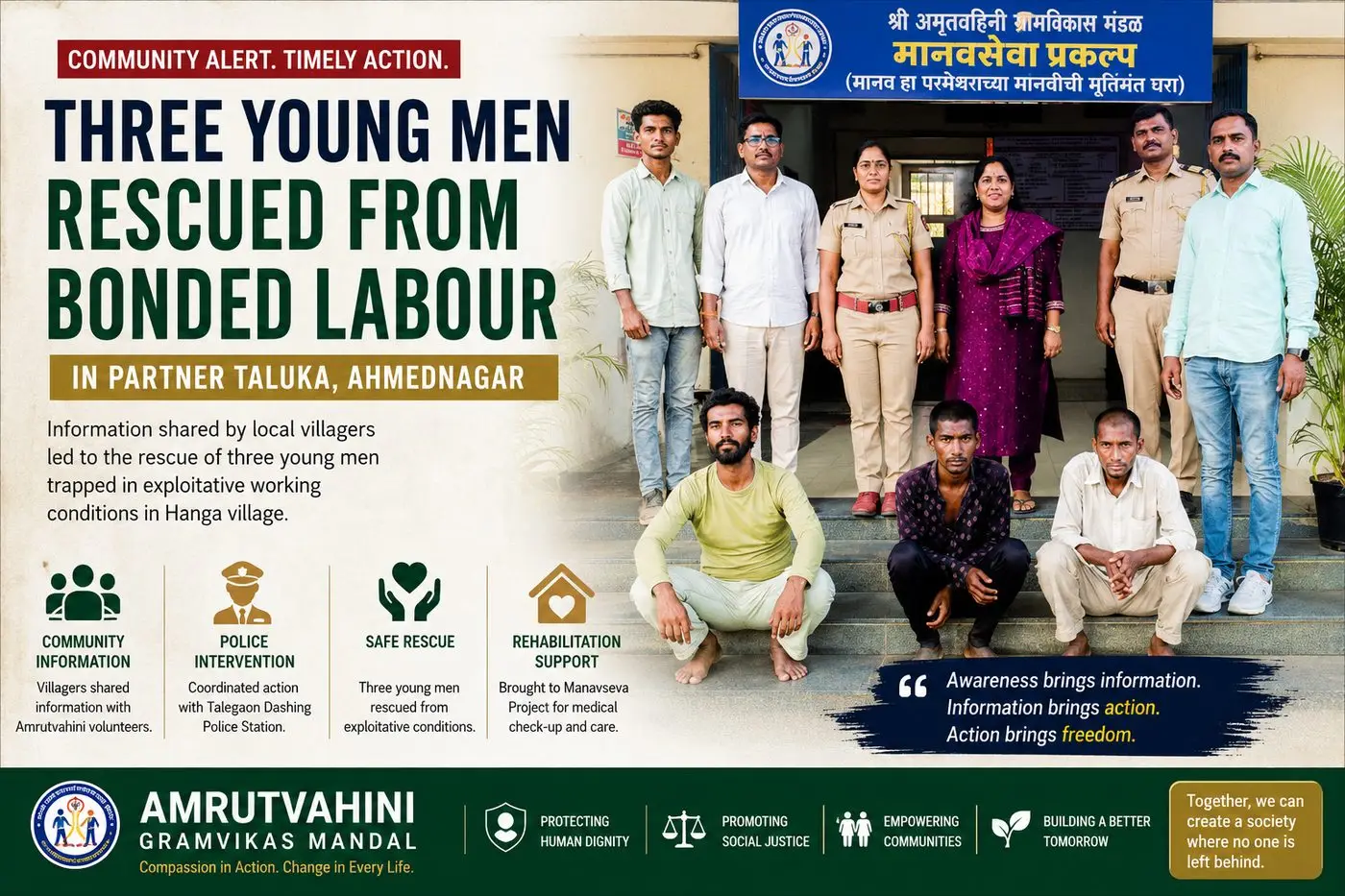
Three young men who were reportedly trapped in bonded labour and exploitative working conditions were rescued following information received by volunteers associated with Amrutvahini Gramvikas Mandal.
The intervention involved coordination with the local police and resulted in the three young men being taken into a safer environment, with further medical assessment and rehabilitation support initiated through the organization's Manavseva Project.
How the Rescue Began
According to the newspaper report, information regarding the situation was received by volunteers of Amrutvahini Gramvikas Mandal from local villagers.
The information concerned three young men who were reportedly being kept in exploitative working conditions in the Hanga area of Parner taluka.
Following the information, representatives associated with the organization visited the area and gathered details about the circumstances in which the young men were living and working.
The organization subsequently coordinated with the police authorities to facilitate their rescue.
This incident demonstrates the importance of community members speaking up when they notice signs of exploitation or forced labour.
Three Young Men Found in Exploitative Conditions
The report states that the three young men had been working under difficult circumstances and were allegedly not being allowed to leave freely.
They were reportedly involved in various forms of labour, including physically demanding work.
The circumstances described in the report included restrictions on their movement and concerns regarding their working conditions and payment.
Such situations can be particularly dangerous for economically vulnerable individuals who may have limited knowledge of their legal rights or may fear retaliation if they attempt to leave.
Community Information Can Save Lives
One of the most important aspects of this incident is the role played by local community members.
The intervention began because information about the young men's circumstances reached people who were able to take action.
This highlights an important principle in preventing labour exploitation:
Awareness is often the first line of protection.
People living in villages and local communities may be among the first to notice when someone is:
- Being forced to work against their will
- Prevented from leaving a workplace
- Denied wages or proper payment
- Threatened or intimidated
- Working under unsafe conditions
- Kept isolated from family members
- Forced to perform excessive or dangerous labour
- Deprived of basic freedom and dignity
Recognizing these warning signs can allow authorities and social organizations to intervene earlier.
Police and Social Organizations Working Together
The rescue also highlights the importance of collaboration between social organizations and law enforcement agencies.
Following the information received, the matter was brought to the attention of the police.
The newspaper report mentions the involvement of personnel associated with the Talegaon Dashing police station, including police officials who assisted in taking action.
The cooperation between community members, social workers and police authorities helped move the three young men away from the reported situation of exploitation.
Such coordinated interventions are essential when vulnerable individuals may not be in a position to seek help themselves.
What Happens After a Rescue?
Rescue is only the first step.
When someone has experienced prolonged exploitation, simply removing them from the situation does not automatically restore their physical or emotional well-being.
They may require:
Medical Assessment
Physical health problems, injuries, malnutrition or other medical concerns need to be identified and addressed.
Psychological Support
People who have experienced fear, coercion or prolonged exploitation may require emotional and psychological support.
Safe Accommodation
A secure environment is essential immediately after rescue.
Rehabilitation
Individuals may need support to regain confidence, stability and independence.
Family and Community Reintegration
Where appropriate, reconnecting individuals with their families and communities can become an important part of recovery.
This is where the Manavseva Project can play an important role.
From Rescue to Rehabilitation Through Manavseva
Following their rescue, the three young men were reportedly brought to the Manavseva Project, operated by Amrutvahini Gramvikas Mandal.
The project works with vulnerable individuals who require care, support and rehabilitation.
Its broader humanitarian approach includes providing an environment where people can receive appropriate support while efforts are made to restore their dignity and stability.
For individuals who have experienced exploitation, rehabilitation can mean much more than providing a temporary place to stay.
It can be the beginning of rebuilding a life.
Why Bonded Labour Remains a Serious Social Issue
Bonded labour is not simply a labour problem.
It is a human rights issue.
When a person is forced or pressured to work because of debt, coercion, threats or circumstances that effectively prevent them from leaving, their basic freedom is compromised.
Vulnerable workers can be particularly susceptible to exploitation when they experience:
- Poverty
- Lack of education
- Unemployment
- Debt
- Social isolation
- Lack of awareness about labour rights
- Dependence on employers for accommodation or basic necessities
Rural and migrant communities can face additional vulnerabilities when individuals travel away from their families in search of employment.
This makes awareness, early identification and accessible support extremely important.
The Importance of Knowing Labour Rights
Workers should be aware that exploitation should not be normalized simply because someone is economically vulnerable.
Every worker deserves dignity and fair treatment.
Communities can contribute to prevention by encouraging people to understand:
- Their employment conditions
- Their right to receive lawful wages
- Their freedom from forced labour
- Where to seek assistance
- How to report exploitation
- How to access government and social support systems
Awareness can make it more difficult for exploitative practices to remain hidden.
Amrutvahini's Role in Humanitarian Social Work
The intervention involving these three young men reflects the broader social-service philosophy of Amrutvahini Gramvikas Mandal.
The organization works across several areas of community development, including:
- Mental health rehabilitation
- Humanitarian support
- Education
- Migrant worker health awareness
- Youth development
- Community welfare
- Rehabilitation of vulnerable individuals
Its Manavseva Project focuses particularly on providing care and rehabilitation to vulnerable people who have been neglected, abandoned or left without adequate support.
The organization's work demonstrates how social development can extend beyond traditional charity.
It can involve identifying problems, intervening in crises and helping individuals rebuild their lives.
A Reminder That Vulnerability Can Be Hidden
The story of these three young men also raises a broader question:
How many vulnerable workers remain invisible because nobody speaks up for them?
Labour exploitation does not always happen in places where outsiders can easily see it.
It can exist behind closed doors, in isolated workplaces or in situations where workers are too frightened or economically dependent to seek assistance.
That is why community awareness matters.
A single phone call.
A piece of information.
A concerned neighbour.
A volunteer willing to investigate.
A police officer willing to intervene.
Together, these actions can change the outcome for someone who has lost the ability to protect themselves.
From Exploitation to Freedom
For the three young men rescued from the reported situation in Parner, the intervention represents an important turning point.
They were moved away from the circumstances described in the report and brought into a setting where their condition could be assessed and their rehabilitation could begin.
Their journey does not end with the rescue.
It begins there.
The long-term goal is to help vulnerable individuals regain:
Safety.
Health.
Confidence.
Independence.
Dignity.
And ultimately, the ability to build a life on their own terms.
Building Communities That Protect the Vulnerable
A strong community is not one where problems never occur.
It is one where people do not remain silent when someone is being harmed.
The rescue of these three young men is a reminder of what can happen when:
Community awareness meets social responsibility.
Social organizations meet law enforcement.
Information becomes action.
And rescue becomes rehabilitation.
Every Person Deserves Freedom and Dignity
The story from Hanga village is more than a local news report.
It is a reminder that vulnerable workers need people willing to notice their circumstances and take responsible action.
For the three young men, the intervention opened a pathway away from exploitation and toward recovery.
For the community, it is a reminder to remain alert.
And for organizations like Amrutvahini Gramvikas Mandal, it reinforces the importance of continuing humanitarian work that protects people who may otherwise remain unheard.
Freedom is a right. Dignity is a right. Every person deserves both.
About Amrutvahini Gramvikas Mandal
Amrutvahini Gramvikas Mandal is a social development organization working across Maharashtra through initiatives focused on mental health rehabilitation, humanitarian support, education, health awareness, youth development and community welfare.
Through projects such as Manavseva, the organization works to support vulnerable individuals and create pathways toward care, rehabilitation and social reintegration.
Help Us Reach More Villages
Your support powers our healthcare, education, and women-empowerment programs across rural Maharashtra.
Support Our Work